
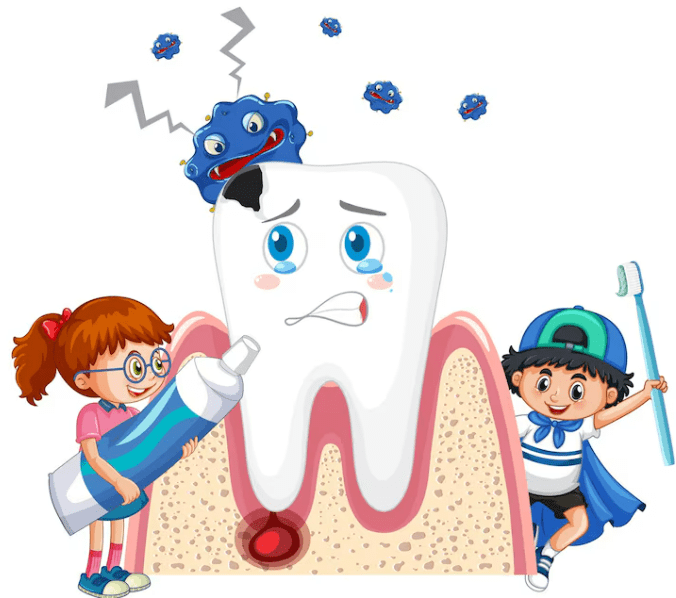
Here is something worth knowing about how tooth decay works in children: by the time it hurts, it has already been going on for a while.
There is no warning. No mild discomfort that builds slowly. A child can have a developing cavity for months — eating normally, sleeping normally, giving no sign at all — and then one day it reaches the nerve and everything changes. What would have been a ten-minute fluoride treatment six months ago is now a procedure under sedation.
That gap between “nothing seems wrong” and “something is very wrong” is exactly where preventive fluoride treatment lives. It is not dramatic. It does not feel urgent. It is just the thing that quietly prevents the situation from becoming one.
Most Indian parents have not had fluoride treatment properly explained to them. Not because dentists don’t recommend it — they do — but because a two-line mention at the end of a visit does not really land. So this article is the longer version. The version with the context.
Children’s Teeth Are Not Small Adult Teeth. They’re Different.
This surprises people. A child’s enamel — the outer layer of the tooth, the hard part — is about 2.5 times thinner than an adult’s. It is also more porous. That combination matters because acid from oral bacteria does not just sit on the surface of a child’s tooth the way it might on an adult’s. It gets in. Faster, deeper, with less resistance.
Where does the acid come from? Bacteria in the mouth break down fermentable carbohydrates — rice, bread, biscuits, fruit, milk — and produce acid as a by-product. This happens every time a child eats. Several times a day, every day. These are not unhealthy foods. They are the foods children eat. But the acid load is constant, and thin porous enamel is not well-equipped to handle it indefinitely without support.
Brushing helps. It removes plaque, disrupts bacterial colonies, and is absolutely necessary. But brushing twice a day cannot fully compensate for what thin enamel faces in terms of daily acid exposure. It was never designed to. That is not a failure of brushing — it is simply a limitation that fluoride treatment is specifically designed to address.
Fluoride works through remineralisation. When fluoride is present on the tooth surface, it is absorbed into the weakened mineral structure of the enamel and rebuilds it — not as a coating over the top, but within the actual tooth structure. The rebuilt enamel is harder and more acid-resistant than before. This is not a temporary fix. It is structural reinforcement.
What Fluoride Treatment Actually Looks Like
The most common form is fluoride varnish, and it is considerably less dramatic than the name might suggest.
A dentist or hygienist uses a small soft brush to paint a concentrated fluoride solution directly onto the teeth. The whole application takes under two minutes. There are no needles, no drills, no unpleasant sounds, nothing that vibrates. The varnish sticks on contact with saliva, sets almost immediately, and then releases fluoride slowly and steadily into the enamel — mostly over the following night while the child sleeps.
It comes in bubblegum and strawberry flavours. This is not a marketing decision — it genuinely makes the procedure easier for young children who might otherwise object to something unfamiliar in their mouth.
Aftercare is two things: soft foods for a few hours after the application, and skip brushing that evening. That is the entire aftercare plan. The varnish needs to sit undisturbed overnight to do what it is meant to do. Normal routine from the next morning.
The evidence behind fluoride varnish is not new or contested. Studies consistently show it reduces cavities in baby teeth by over 30% when applied on schedule. For most Indian children, that schedule is every three months — the diet in this context warrants that frequency. For children assessed as lower risk, every six months is generally appropriate.
Two minutes. Four times a year. Thirty percent reduction in cavities. There is no complicated version of that trade-off.
Silver Diamine Fluoride: When Decay Is Already There
Fluoride varnish is prevention. Silver diamine fluoride (SDF) is something else — it is for situations where early decay has already started, particularly when conventional drilling is not straightforward.
SDF is a clear liquid applied directly to a decayed area. The silver kills the bacteria driving the decay. The fluoride hardens the damaged tooth structure below it. Together they arrest the cavity — stop it from progressing further — without any drilling, any noise, any sedation, or any injection.
This is particularly useful for very young children, anxious children, and children with conditions that make conventional treatment genuinely difficult. When the alternative involves sedation or general anaesthesia for a toddler, SDF changes the conversation entirely.
One thing to know before going ahead: silver diamine fluoride turns the treated area black. Properly black, not slightly discoloured. This should be explained clearly before the treatment, not after. Parents who are told in advance handle it fine. Parents who notice it without warning do not.
For most families, once the choice is laid out plainly — a dark spot on a baby tooth that will fall out in a year or two, versus a procedure under sedation for a three-year-old — the decision is not difficult. SDF is a tool for a specific situation. Used in that situation, it is a good one.
About the Fluoride Safety Question
This comes up often, usually via a forwarded article or a family group chat, and it deserves a real answer rather than a dismissal.
The concern originates from something real: in parts of India — Rajasthan, Andhra Pradesh, Telangana — groundwater naturally contains very high levels of fluoride. People in these regions who drink this water every day over many years can develop fluorosis: staining, pitting of the enamel, and in severe cases, bone complications. This is a documented public health problem.
It has no connection to what happens in a clinical fluoride treatment.
A professional fluoride application involves a small, measured amount painted onto the tooth surface. It sets within seconds. It is not swallowed. It does not circulate in the blood. The mechanism of harm in fluorosis is chronic ingestion of high-fluoride water over years. That mechanism is entirely absent from a clinical application. The word “fluoride” appears in both situations. That is the only thing they share.
Over seventy years of research, across every continent, supports the safety and effectiveness of professional fluoride treatment. The WHO, the Indian Dental Association, the American Academy of Pediatric Dentistry, and every equivalent body worldwide recommends it. The safety record is not ambiguous.
Baby Teeth Are Not Throwaway Teeth
The “they fall out anyway” reasoning comes up frequently and it is worth addressing plainly.
Baby teeth hold space. That is one of their functions. Each primary tooth occupies a position in the jaw that is being reserved for the permanent tooth forming directly below it. Lose that tooth early to decay — especially before age five or six — and the neighbouring teeth drift into the gap. The permanent tooth arrives and there is no room. It erupts crowded, rotated, or out of position. Many adolescents undergoing years of orthodontic treatment are there, at least in part, because of baby teeth that were lost too early.
The second issue is more immediate. A decaying primary tooth sits directly above the permanent tooth developing beneath it. The bacteria, the acid, and the infection associated with an untreated cavity are in constant proximity to the permanent tooth before it has ever emerged. Damage to that permanent tooth can begin before it is visible.
And separately from all of that: a child with active tooth decay is a child in pain. Possibly not expressing it clearly, possibly not connecting it to teeth, but in pain. Children with dental pain eat less, sleep worse, miss school more, and by documented research, perform worse academically than peers without it. This is not a trivial matter.
When choosing a provider, the difference between a general dentist and a paediatric specialist matters more than most parents realise. The Best Pediatric Dental Clinic for Kids in India has dentists whose entire training is focused on children — their development, their psychology, their particular anatomy, and their very specific relationship with dental appointments. The Best Pediatric Dentistry in India has changed substantially. Child-sized instruments, child-appropriate environments, staff trained specifically to manage anxiety. The experience is genuinely different.
The Only Appointment That’s Too Late Is the One Not Booked Yet
Prevention works when there is nothing yet to prevent. That is not a paradox — it is just how it functions. Fluoride treatment applied to intact enamel strengthens it before acid has done damage. Fluoride treatment applied once decay has begun is doing a different, harder job.
The families who consistently maintain preventive dental care do not do so because they have unusual discipline or more time. They do so because at some point someone explained clearly why the appointment when nothing is wrong is the important one. That is what this article is trying to do.
If a fluoride treatment has not happened in the last six months — or has never happened — that is the thing to act on. Not next week. Not once the term settles down. Now, while the enamel is still intact and the window for prevention is open.
Questions Parents Actually Ask
The real questions, worded the way they actually come up.
My child only has four teeth. This seems excessive for four teeth.
Those four teeth are being attacked by acid every time the child feeds — which is frequently. The children who arrive at age seven with the healthiest teeth are almost universally the ones whose parents started early and stayed consistent. Not because of any single treatment, but because of the habit that accumulated over years. Four teeth is exactly the right time to start.
My child will not cooperate. Getting near his mouth is already a fight.
Fluoride varnish is one of the better procedures for this specific situation. The application is sixty seconds with a small soft brush. Nothing noisy, nothing sharp, nothing that vibrates. Children who walk in already crying are often done before they have had time to fully escalate. It is worth attempting even in a difficult child because the upside is real and the procedure is genuinely fast. If it is not possible that visit, try again next time. Repeated short positive experiences are how dental anxiety resolves — not avoidance.
Every three months sounds like a lot. Can we do every six?
For most Indian children the three-month interval is what the evidence supports, given dietary patterns in this context. Every six months is appropriate for children assessed as low risk. That assessment should come from the treating dentist, not from the family’s schedule. If three months feels unmanageable, the most useful thing is to book all four appointments at once before leaving the clinic, put them in the calendar, and treat them like vaccinations: fixed, not moveable.
We use fluoride toothpaste. Are we not already covered?
Not fully, no. Toothpaste delivers a low concentration of fluoride across a two-minute brushing session. Clinical fluoride varnish delivers a significantly higher concentration directly to the tooth surface and releases it into the enamel over several hours. The mechanisms are different, the depth of effect is different, and the two are genuinely complementary. Toothpaste is necessary and not sufficient. Both are recommended.
There is already a small hole. Is it too late?
Possibly not. If the cavity is early to moderate, silver diamine fluoride may be able to arrest it without drilling. If it has progressed further, conventional treatment will be needed. The key thing is not to decide before an examination has been done. Many parents come in braced for significant treatment and find the situation is more manageable than they feared. Come in, let a proper assessment happen, and make decisions from there.
My mother-in-law is certain fluoride is toxic. How do I handle this?
The concern comes from a real place: areas of India where naturally high fluoride in groundwater has caused problems in communities that drink it daily for years. That is a real issue. A clinical fluoride varnish is a topically applied treatment — it is painted on the tooth, sets within seconds, and is not ingested. The only thing these two situations share is the word fluoride. Seventy years of research, the WHO, the Indian Dental Association, and every major paediatric health body in the world back the clinical application. The anxiety is understandable; the risk is not.
Can I just buy a fluoride rinse from the pharmacy instead?
Under six, no. Children this age cannot reliably rinse and spit — they swallow. This is developmental, not a matter of instruction. Clinical varnish works precisely because it requires none of that. It is applied by a professional exactly where it needs to go, and it stays. For older children who have genuinely mastered spitting, rinses can be a useful supplement. They do not replicate the concentration or sustained-release effect of professional varnish.
What do we need to do after the treatment? I always forget the instructions.
Two things only: soft foods for a few hours, and skip brushing that one night. The varnish needs to sit overnight to work properly. If brushing happens accidentally, it is not a crisis — just not ideal. Come back in three months and the cycle continues. Any good clinic will put the instructions in writing before you leave.
