
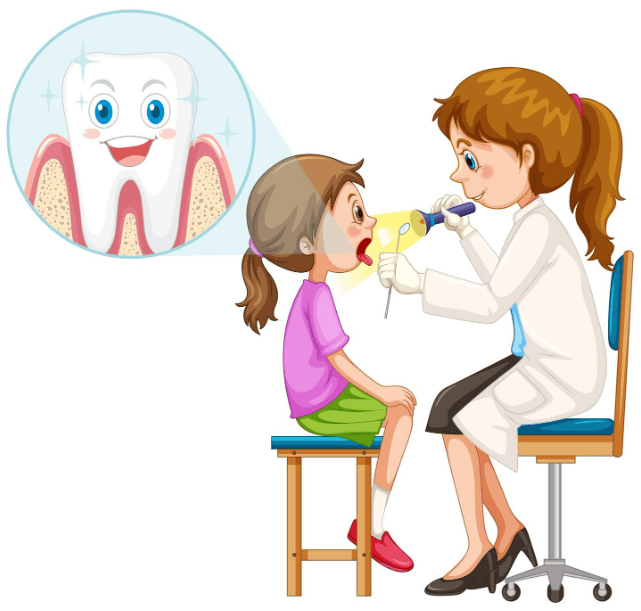
When did your child last have a dental checkup?
If the answer required some thought — or involved phrases like “sometime last year” or “maybe before the pandemic” — this article is for you.
The dental checkup is one of those appointments that parents consistently underestimate. Not because they don’t care about their children’s health — clearly they do — but because dental problems in children are famously silent. A cavity can develop for months without any pain, any visible change, any sign at all. The child is eating, sleeping, going to school normally. And underneath that, decay is progressing steadily toward the nerve.
By the time something hurts, the easy window has closed. What was a ten-minute fix three months ago is now a much longer conversation.
The regular dental checkup is not the appointment you book when something is wrong. It is the appointment that makes sure something wrong gets caught before it becomes worse. That distinction matters more than it sounds.
“But He’s Not Complaining About His Teeth”
This is the single most common reason dental appointments get delayed, and it is worth understanding why it is not a reliable measure.
Tooth decay in children progresses through stages. In the earliest stage, the enamel is weakening. No cavity yet. No pain. No visible sign. This stage is completely reversible with the right preventive treatment and requires no drilling at all.
As decay works through the enamel into the softer dentine below, a cavity forms. Still often painless. Still not visible to a parent looking in a child’s mouth without instruments or proper lighting. A dentist can see it at this stage. Without a visit, nobody can.
When the decay reaches the pulp — the nerve at the centre of the tooth — pain begins. This is the moment most families realise something is wrong. By this point, treatment is significantly more involved: root canal, extraction, or in a young child, often sedation.
“Not complaining” does not mean nothing is happening. It means the decay has not reached the nerve yet. That is a description of timing, not of health.
A regular dental checkup is the only mechanism that catches decay at the earlier, more manageable stages. There is no equivalent at home.
What a Dental Check Up and Clean Actually Does
Part of why parents undervalue the checkup is that they are not sure what is being checked. It is worth being specific.
The examination part of a dental check up and clean covers every tooth surface: front, back, sides, and the spaces between. It assesses gum health — something most parents do not think about but which matters significantly, because gum disease in children is more common than most expect. It looks at bite development: whether the jaw is growing symmetrically, whether teeth are meeting correctly, whether any permanent teeth are delayed or arriving in the wrong position.
The dentist is specifically looking for changes in the enamel surface — texture shifts, softened areas, colour changes in the molar grooves — that indicate the very beginning of decay. These signs are visible to a trained eye with proper lighting and instruments. They are not visible in a mirror at home. This is the detection window that the dental check up and clean exists to catch.
The cleaning component removes calcified plaque — tartar — from the teeth and gum line. Once plaque hardens into tartar, no toothbrush will touch it. It has to be removed professionally. Tartar accumulation at the gum line is the primary driver of gum disease, and it builds faster than most parents realise.
There is also something less obvious happening at every visit: the dentist is building a longitudinal picture. “This spot looked different six months ago.” “The bite has shifted since we last saw this child.” That kind of pattern recognition only exists if there have been regular prior visits. A dentist seeing a child for the first time at age ten, with a gap of two years since the last appointment, has no baseline. They are starting from zero.
How Often. And Why That Number Is Not Negotiable.
Every six months. That is the standard recommendation and it is the minimum, not the ideal.
For children at higher risk — a history of cavities, diet heavy in carbohydrates and sugar, inconsistent brushing, family history of dental disease — every three to four months is more appropriate. The treating dentist should make that call based on the individual child.
Six months is a long time in a child’s mouth. New teeth are erupting. Old ones are shifting. Decay can begin and advance substantially within that window. It is genuinely not a conservative interval — it is the minimum required to catch problems in the earlier, cheaper stages.
The most practical advice: book the next appointment before leaving the current one. Families that rely on remembering to call six months from now consistently present later than intended. It is not a failure of intention — life is busy and non-urgent appointments slip. Book it now, calendar it, treat it the same way a vaccination appointment is treated. Fixed.
What the Teeth Checkup Is Actually Looking For — Beyond Cavities
Cavities are the most understood purpose of a teeth checkup. They are not the only one, and some of the others matter considerably.
Bite development is assessed at every visit. Malocclusion — abnormal alignment of the teeth or jaws — is significantly easier to address when identified early. A problem caught at seven or eight may require simple monitoring or a short course of interceptive treatment. The same problem identified at fourteen typically means two-plus years of comprehensive orthodontics. The window genuinely closes.
Gum health is evaluated. Inflamed or bleeding gums in a child are not normal. They are not caused by brushing too hard. They are caused by bacterial plaque at the gum line and, if unaddressed, can progress. Gingivitis affects a significant proportion of children and adolescents in India and is almost entirely manageable when caught and treated early.
Grinding patterns are identified. Bruxism leaves wear marks on tooth surfaces that are visible during a teeth checkup long before any parent would notice them. Identifying it early allows protective measures to be put in place.
Soft tissue is examined: gums, cheeks, tongue, palate. Unusual lesions or growths in a child’s mouth are uncommon but do occur. Caught at a routine teeth checkup, they can be evaluated and referred promptly. Found years later because appointments were skipped, the situation is predictably more complex.
A dental checkup is a complete oral health assessment. The fact that it takes thirty to forty-five minutes and involves no pain does not mean very little is happening.
When a Child Is Scared of the Dentist
Dental anxiety in children is common and its consequences compound over time. Skipping appointments because of anticipated difficulty means problems accumulate. When the child eventually does attend — usually because of pain — the appointment is longer, more complex, and more frightening. The fear feeds itself.
The way through it is not avoidance. It is short, neutral visits where nothing uncomfortable happens. A checkup that ends with a child who is bored rather than distressed. Then another. Then another. Repeated uneventful visits systematically dismantle dental fear in a way that nothing else quite does.
If a previous dental experience was genuinely bad, it is completely reasonable to change providers. Not every dentist is equally suited to working with children — that is not a criticism, it is simply true. A paediatric dentist has specific training in child development and behaviour management. For a highly anxious child, that training makes a real difference in how the appointment is experienced.
The Best Pediatric Dental Clinic for Kids in India operates in environments specifically designed to reduce the fear response in children — not clinical environments adapted for children, but environments built from the start with children in mind. The Best Pediatric Dentistry in India today is different from what most parents experienced growing up. It does not have to be the appointment that ruins the week.
The Money Part, Said Directly
A routine dental checkup is one of the least expensive dental appointments that exists. A filling costs more. A root canal costs significantly more. A crown costs considerably more than that. An extraction followed by space management followed by the orthodontic consequences of early tooth loss — the bill at that end is a different order of magnitude entirely.
Every rupee spent on a regular dental checkup is reducing the probability of a much larger bill later. This is not a commercial argument. It is the arithmetic of how dental disease progresses when left undetected.
For families for whom cost is a genuine barrier, government dental colleges and certain public hospitals provide basic dental checkup services at very low or no cost. A child seen somewhere is better served than a child not seen at all. These options exist and are worth knowing about.
Questions Parents Actually Ask
The real questions, worded the way they actually come up.
Teeth look completely fine. Do we really need to go?
Yes — and this is precisely the right time to go. When there are no symptoms, the appointment is quick, inexpensive, and if nothing is found, completely uneventful. Early decay is invisible from outside the mouth and produces no pain until it has progressed substantially. “Looks fine” is not the same as “is fine.” A dental checkup is how you find out which one is actually true.
At what age should the first dental checkup happen?
First tooth or first birthday, whichever comes first. This sounds early and it is — intentionally. The first visit is not typically about finding problems. It is about getting the child comfortable with the environment before anything difficult happens, checking that development is on track, and giving parents clear guidance on brushing and diet for this age. The head start that creates matters long after that first visit.
My daughter had a terrible experience last year and refuses to go now. What do we do?
Find a paediatric dentist if you haven’t already, and book an appointment with no clinical treatment planned. Just a visit: a look around, maybe a tooth count, a sticker, and home. No treatment. The aim is one appointment that ends without anything uncomfortable happening. Then another. The fear from one bad experience is dismantled the same way it built up — incrementally, one experience at a time. It requires patience, but it works. A child-specific environment and a dentist trained for this makes it go faster.
We see a general dentist. Is a specialist really necessary?
Not for every child. Some general practitioners are experienced and effective with children. But for very young children, highly anxious patients, children with special needs, or any child who has had repeated difficult experiences — a paediatric dentist’s specific training in child development and behaviour management makes a real clinical difference. If the current appointments consistently go badly, changing to a specialist is worth trying.
How long does a dental check up and clean take? We have a very packed schedule.
A straightforward dental check up and clean with no issues to address takes thirty to forty-five minutes. That covers the exam, the clean, and the conversation about findings. Less than most school drop-offs. If time is genuinely tight, ask about early morning or weekend slots — most paediatric clinics offer them. The time this appointment takes is not the obstacle it feels like.
We brush twice daily with fluoride toothpaste. Isn’t a teeth checkup a bit much?
Brushing and a teeth checkup are doing completely different jobs. Brushing cleans the accessible surfaces and delivers low-concentration fluoride. It cannot remove hardened tartar, cannot assess bite development, cannot examine gum health, and cannot detect early decay in areas that bristles don’t reach. One does not replace the other. Think of brushing as daily maintenance and the checkup as the professional inspection that tells you how the maintenance is actually working.
Twelve years old, never a cavity. Can we ease up on checkups?
A cavity-free record at twelve is a great outcome. It is not a reason to stop. Twelve to sixteen is actually a higher-risk period: new permanent teeth arriving, increasing dietary independence, decreasing parental oversight of brushing, hormonal changes that can affect gum health. The clean record is worth protecting. Keep the six-month schedule.
Our diet is very healthy and low in sugar. Does this change the checkup schedule?
A genuinely low-sugar diet reduces cavity risk and that may mean every six months is the appropriate interval rather than every three. But the dental checkup covers more than cavities — bite development, gum health, grinding patterns, eruption monitoring. None of those are affected by sugar intake. A healthy diet changes the cavity risk calculation. It does not make the checkup unnecessary.

